

Sleep Apnea: Symptoms, Risks, and Treatments
A plain-language guide to sleep apnea: obstructive vs. central, signs to notice, health risks, how it is diagnosed, and treatment options.

Written by the Complete Sleep editorial team
Pending medical review
Originally published Rewritten 4 min read
What changed September 2026: rewritten from scratch as a sourced explainer; a sample report and “what happens next” added.

Medical reviewer
Sleep Physician · Board-certified in Sleep Medicine
Pending medical review
In short
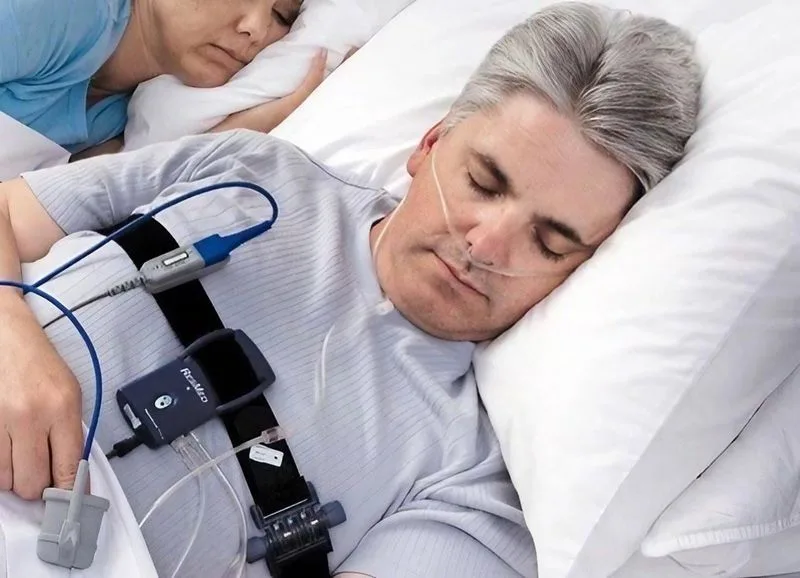
A home sleep apnea test (HSAT) is a small portable recorder worn for one night in your own bed. It measures breathing effort, airflow or arterial signals, oxygen levels, heart rate, and body position to check for obstructive sleep apnea. It is ordered by a clinician, suits people with a high likelihood of moderate-to-severe OSA and no major heart or lung disease, and is not a substitute for an in-lab study in more complex situations.
Key takeaways
A home sleep apnea test (often shortened to HSAT) is a simplified overnight recording done in your own bed. Instead of the dozen or more sensors used in a sleep laboratory, a home test uses a small device — typically worn on the wrist, finger, chest, or nose — that records the signals most relevant to breathing during sleep.
It exists because obstructive sleep apnea is common, sleep laboratories are limited, and for many people a night at home gives a clinician enough information to make a decision.
Most home tests do not record brain activity, so they estimate rather than directly measure sleep and cannot identify sleep stages. That is the main technical difference from an in-lab study.
Clinical guidelines from the American Academy of Sleep Medicine recommend home testing for adults who are likely to have moderate-to-severe obstructive sleep apnea and who do not have conditions that make the recording unreliable. In practice that means:
Which one is right for you is a clinical decision. The questions a clinician asks before ordering a test are as important as the test itself.
Reports usually describe how many breathing events happened per hour of recording — the apnea-hypopnea index (AHI) or a similar index — along with oxygen findings and, where available, position effects. Broadly, fewer than 5 events per hour is considered within the normal range for adults, 5–14 mild, 15–29 moderate, and 30 or more severe. Those thresholds are a starting point for a conversation with your clinician, not a verdict on their own: symptoms, other health conditions, and the quality of the recording all shape what happens next.
A typical home-test report is a page or two. The line that matters most reads something like: “Recording time 6 h 40 min. Respiratory event index 18.4 per hour. Lowest oxygen saturation 84%; 12% of recording time below 90%. Events predominantly supine (31 per hour on the back, 9 per hour on the side).” Read that as: enough data to interpret; breathing events at a rate in the moderate range; oxygen dipping meaningfully during them; and a clear positional pattern, which sometimes opens up treatment options beyond CPAP. The index is called a respiratory event index (REI) on most home tests rather than an AHI, because the device estimates rather than measures sleep time — which is also why a home result can understate the true severity.
A home sleep apnea test is a practical, evidence-supported way to check for obstructive sleep apnea in the right person. It is ordered and interpreted by a clinician, it has clear limits, and it is one step in a process rather than the whole answer. If you recognise the symptoms described here, the most useful next step is a conversation with your own doctor about whether testing makes sense for you.
Rules vary by country and province or state. In most places a home sleep apnea test is a prescribed medical test ordered and interpreted by a clinician, and results are only meaningful with that interpretation.
For adults likely to have moderate-to-severe obstructive sleep apnea, home tests agree well with in-lab studies. They are less reliable for mild cases and for people with other significant medical conditions, which is why clinicians choose the test type case by case.
Inconclusive or technically poor recordings are common enough that repeat testing, or an in-lab study, is a normal next step rather than a sign that something went wrong.
Related reading
Two-minute check
Wondering about snoring or daytime sleepiness? STOP-Bang is scored in your browser.
Take the self-checkA plain-language guide to sleep apnea: obstructive vs. central, signs to notice, health risks, how it is diagnosed, and treatment options.
2-minute tool
Eight yes/no questions, scored in your browser. A starting point for a conversation with your doctor.
Take the self-check